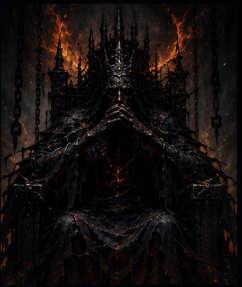
The Quiet King
Origin
Before the Ember Throne became a place of pilgrimage, it was a place of making. The old kingdoms of the ashlands had little stone and less fertile ground. What they possessed was iron. Their people learned early that survival belonged to builders. Every settlement centered around a forge. Every ruler was expected to work. Kings judged disputes in the morning and stood at the anvil by evening. Among those rulers was King Edran. He became legendary. Not because he conquered. Because he repaired. When roads washed out, he rebuilt them. When furnaces cracked, he joined the workers. When neighboring kingdoms failed, he sent hammers before soldiers. His people adored him. As the kingdom prospered, heroes began bringing him problems. At first this was sensible. Then convenient. Then habitual. Builders stopped solving. Foremen stopped deciding. Families delayed repairs until the king could inspect them. Edran answered every request. He worked longer. Slept less. Solved more. His court became efficient. Then dependent. Years later one apprentice entered the throne hall carrying a broken forge latch. The king repaired it. The apprentice returned the next day with a loose hinge. Then a warped tool. Then a bent nail. Edran fixed all of them. The apprentice finally asked— "What would happen if you said no?" Witnesses say the king stared at the question for a long time. Then looked around the hall. Broken things surrounded him. Nothing serious. Nothing impossible. But none of it belonged there. That winter Edran dismissed his court. Closed the forge. Ascended the Ember Throne. When the doors reopened months later, he still sat there. No guards. No decrees. No hammer. Only watching. Heroes approached with problems. He asked questions. Few liked the answers. The Quiet King had taken the throne.
Domain
The Quiet King rules the Hall of First Fires. It lies above the ash plains where old forge smoke still drifts through black stone arches. The hall is enormous. Rows of cold anvils stretch outward. Hundreds of workbenches stand unfinished. Half-made tools rest where someone expected another person to complete them. At the center rises the Ember Throne. Not gold. Not jeweled. Iron. Scored with hammer marks. The King sits there quietly. Hands resting on his knees. Watching the room. Waiting.
Signs of Presence
The first sign is urgency. Every problem suddenly feels immediate. The second sign is escalation. Heroes begin seeking help before attempting solutions. Then comes stillness. Someone finally asks— "What is actually causing this?" The room becomes warmer. The King is listening.
Powers
Ash of Symptoms Immediate fixes cover deeper faults without removing them. Borrowed Hammer Heroes surrender responsibility to stronger builders. Cold Anvil Work pauses while waiting for perfect instruction. Throne of Dependence Every solved problem creates another request.
Weakness
The Quiet King cannot survive honest diagnosis. He grows stronger where heroes chase symptoms and avoid root causes. He feeds on dependence. He weakens when problems are broken apart, understood, and addressed at their source. His enemy is not action. His enemy is thoughtful action. He yields to heroes willing to sit with discomfort long enough to understand before they repair.
How You Defeat It
Your clan enters carrying broken tools. The King gestures for you to approach. One by one you present the problems. He does not take them. He only asks questions. What changed. When did it begin. What have you already tried. What would happen if you did nothing. At first the questions feel frustrating. Then patterns appear. Three failures trace back to one cracked furnace. Four disputes began with one unclear instruction. Five repairs were fixing consequences instead of causes. Your clan returns to the benches. You repair fewer things. You solve more. The hall changes. Cold anvils warm. Forge fires reignite. The pile of broken tools disappears. Eventually you return to the throne. The King stands. Walks down the steps. Places a forge hammer in your hands. And says— "Now build." Then he leaves the hall. No one follows.
Quote
"You brought me broken tools. I was waiting for someone to bring the broken forge."