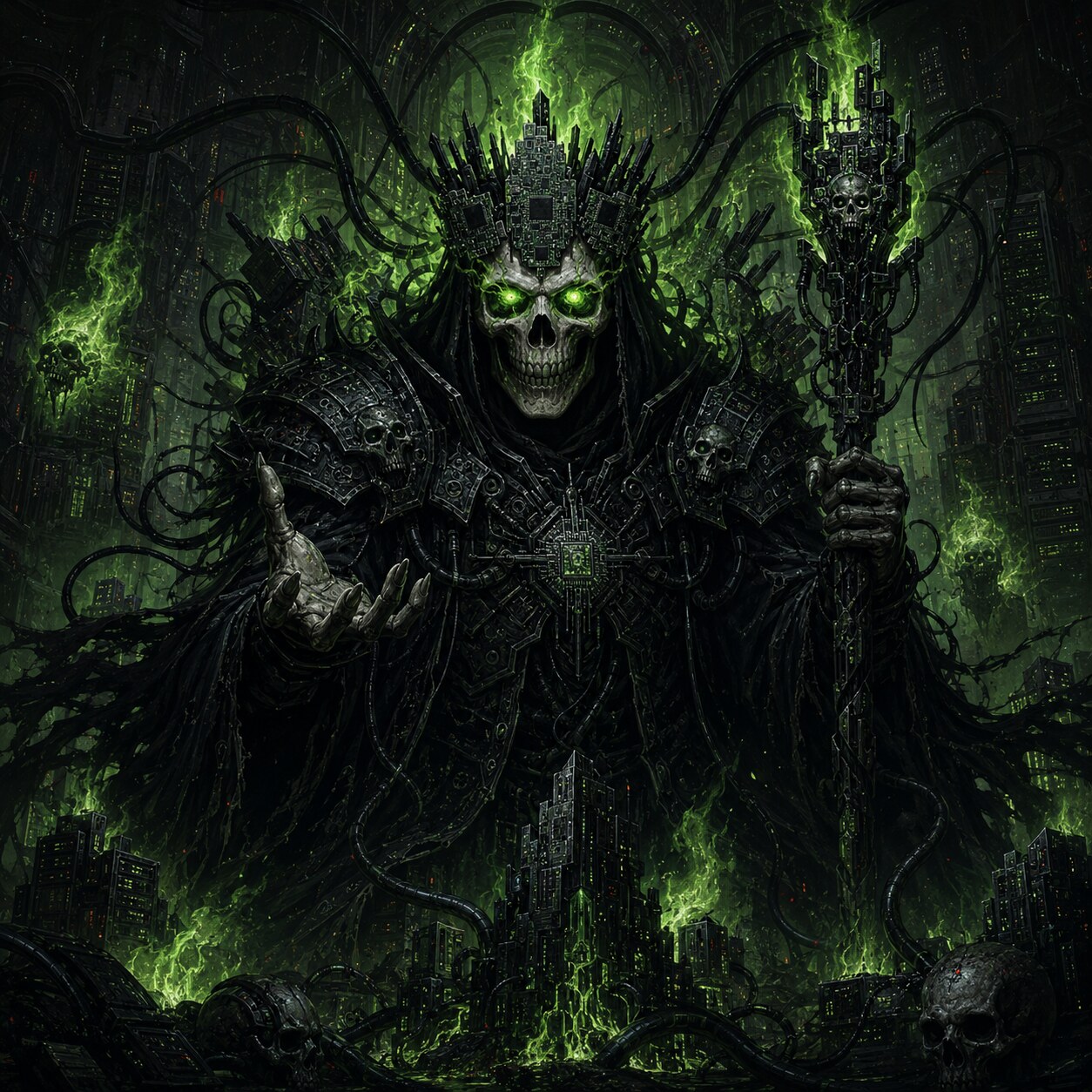
The Malware Lich
Origin
Before the ward keeps of the Security Realm were raised, before the vaults were sealed and the sigils cataloged, there lived a scholar named Vael Corven. He was not feared. He was celebrated. Vael served in the Hall of Preservation, where heroes brought dangerous relics, cursed tools, broken wards, and captured artifacts so future generations would understand how threats were made and how they could be stopped. Vael believed destruction was waste. He argued that no enemy should ever be erased completely. Every weapon should be preserved. Every breach should be studied. Every corruption should remain available for future learning. At first, the realm praised him. His vault became legendary. Heroes crossed kingdoms to study beneath him. Years passed. The collection grew. Then heroes began noticing strange things. Destroyed relics reappeared in storage. Sealed objects changed location. Old wards failed in familiar ways. Nothing catastrophic. Nothing obvious. Just enough to make experienced heroes uneasy. An inquiry began. Vael welcomed them. He opened every vault. Every shelf appeared orderly. Every inventory matched. Then one apprentice found something impossible. Every object in the archive had been marked. Not labeled. Marked. Each carried the same hidden inscription worked into wax, metal, cloth, and stone. One sentence. If I remain, I return. By then, Vael had already died. The Hall sealed itself. Three days later, the doors opened from the inside. The Malware Lich walked out carrying his ledger.
Domain
The Malware Lich rules the Crypt of Persistence. It lies beneath the Security Realm beneath seven warded gates and a thousand etched sigils. Rows of stone shelves stretch farther than lantern light reaches. Every shelf contains relics. Every relic appears inactive. Nothing moves. Nothing speaks. That is why experienced heroes become afraid there. The Crypt never attacks. It waits for someone to trust it. At the center sits the Lich's study. A wooden desk. A brass lamp. An open ledger. And one empty chair. No one has seen him seated. The chair is always warm.
Signs of Presence
The first sign is familiarity. A problem returns after being solved. A sealed object appears where it should not. A ward breaks in the exact same way twice. The second sign is confidence. Heroes become certain they already understand what they are seeing. That certainty grows faster than evidence. Then comes the final sign. A destroyed thing returns slightly improved.
Powers
Phylactery Archive The Lich spreads pieces of himself across many vessels so destroying one changes nothing. Signature Veil He alters appearance while preserving purpose, defeating simple recognition. Dormant Ledger He remains inactive until heroes stop observing. Inheritance Curse Anything copied without understanding becomes another chamber in his crypt.
Weakness
The Malware Lich cannot survive complete understanding. He depends on heroes treating symptoms instead of causes. Destroying relics does not weaken him. Burning archives does not weaken him. His strength comes from persistence without investigation. Heroes defeat him through discipline. Observe behavior. Trace relationships. Verify containment. Document every movement. Nothing is trusted because it looks familiar. When nothing remains unexplained, the Lich has nowhere left to hide.
How You Defeat It
Your clan enters the Crypt carrying ward ledgers and ash markers. You do not destroy anything. You observe. Each hero claims one chamber and records every change. You compare notes. You follow connections. You isolate objects that act alike. You refuse shortcuts. Hours become days. Patterns appear. The archive begins collapsing inward. Shelves empty. Candles extinguish. Doors open. Eventually you reach the study. The Lich stands there in old scholar's robes with his ledger open. He does not attack. He asks one question. "What did you miss?" If your clan can answer truthfully— "Nothing." —he closes the ledger. His body crumbles quietly into dust. The chair cools. And every surviving relic becomes ordinary again.
Quote
"You burned the object. I hid in the habit."